
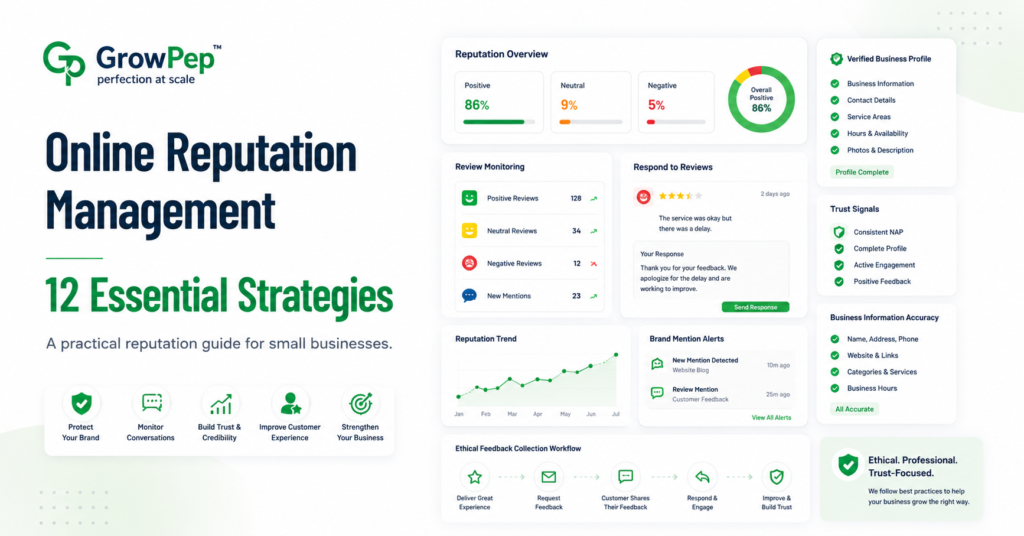
Online reputation management for small businesses is the process of monitoring how a company appears online, responding professionally to customer feedback, correcting inaccurate business information, strengthening trust signals, and managing potential reputation risks.
For many small businesses, a potential customer’s first impression may come from a Google Business Profile, review platform, social media page, local directory, search result, or company website. Incomplete information, unanswered reviews, inconsistent branding, or unresolved complaints can influence whether that customer contacts the business.
Reputation management should not involve buying reviews, creating fake accounts, suppressing honest criticism, pressuring customers for positive ratings, or promising guaranteed removal of legitimate negative feedback. A responsible strategy focuses on authentic customer experiences, professional communication, accurate information, and long-term trust.
This guide explains 12 practical and ethical online reputation management strategies that small businesses can use to build a stronger digital presence.
What Is Online Reputation Management?
Online reputation management involves reviewing, improving, and protecting the information people find about a business online.
This may include:
- Monitoring customer reviews and ratings
- Responding to positive and negative feedback
- Maintaining accurate business information
- Managing Google Business Profile content
- Monitoring social media mentions
- Improving website trust signals
- Reporting content that violates platform policies
- Creating an ethical customer feedback process
- Preparing for complaints or reputation incidents
- Tracking reputation trends over time
The objective is not to create an artificially perfect image. The objective is to help customers find accurate information, understand how the business communicates, and see evidence of responsible customer service.
Why Online Reputation Management Matters for Small Businesses
Small businesses often depend heavily on local visibility, referrals, repeat customers, and community trust. A limited number of reviews, an outdated profile, or a highly visible unresolved complaint may have a noticeable effect on customer perception.
A strong reputation system can help a business:
- Identify customer concerns earlier
- Respond consistently across platforms
- Improve business information accuracy
- Build confidence before a customer makes contact
- Learn from recurring feedback
- Reduce confusion caused by outdated listings
- Prepare for potential reputation risks
Reputation management cannot guarantee positive reviews, specific ratings, increased sales, content removal, or search rankings. Results depend on customer experience, competition, platform policies, service quality, communication, and other factors outside the control of any agency or software.
Online Reputation Management for Small Businesses: 12 Essential Strategies
1. Audit Your Current Online Reputation
Start by identifying what customers currently see when they search for the business.
Search for:
- The official business name
- Business name plus location
- Business name plus reviews
- Business name plus complaints
- Owner or leadership names where relevant
- Main products or services
- Important branded terms
Review the first few pages of search results and document:
- Google Business Profile information
- Major review-platform listings
- Social media accounts
- Local business directories
- News or community mentions
- Old websites or duplicate listings
- Incorrect phone numbers, addresses, or opening hours
- Unanswered reviews
- Content that may violate platform policies
Create a simple reputation inventory showing the platform, profile URL, login ownership, review count, rating, last activity, information accuracy, and any action required.
2. Claim and Verify Important Business Profiles
A business should control the profiles that represent it on major platforms. Unclaimed or unmanaged listings may contain outdated details, incorrect categories, duplicate information, or unanswered customer questions.
Depending on the business, important profiles may include:
- Google Business Profile
- Yelp
- Industry-specific directories
- Local chambers or business associations
- Relevant marketplace profiles
Use an official company email address where possible and keep a secure record of profile owners, managers, recovery methods, and login credentials.
Google requires a Business Profile to be verified before the business can reply to reviews. Review Google’s official guidance on managing customer reviews.
3. Keep Business Information Accurate and Consistent
Customers may lose trust when they find different phone numbers, addresses, business names, website links, or operating hours across platforms.
Review and standardize:
- Business name
- Physical address or service area
- Phone number
- Website URL
- Regular and special opening hours
- Business category
- Service descriptions
- Appointment or booking links
- Logo and cover images
Information should accurately represent the real business. Avoid adding unnecessary keywords to the business name or creating misleading locations.
Google advises businesses to keep profile information complete and current so customers can understand what the business offers and when it is available.
4. Monitor Reviews and Brand Mentions Regularly
Monitoring allows the business to identify new feedback before it is overlooked or becomes more difficult to manage.
Create a monitoring schedule for:
- Google reviews
- Industry review platforms
- Facebook recommendations and comments
- Social media mentions
- Relevant local directories
- Customer support channels
- Branded search results
The monitoring frequency should reflect the volume of customer activity. A busy restaurant, clinic, ecommerce store, or home-service company may need more frequent checks than a business receiving only a few reviews each month.
Record important details such as the date, platform, rating, topic, response status, escalation requirement, and resolution status. Avoid storing unnecessary personal customer information.
5. Respond Professionally to Customer Reviews
Review responses are public communications. They are written for the reviewer, but future customers may also read them when evaluating the business.
A useful response should generally be:
- Professional
- Specific to the feedback
- Respectful
- Brief enough to remain clear
- Free from confidential customer information
- Focused on a practical next step when required
Responding to positive reviews
Thank the customer and, where appropriate, acknowledge a specific part of their experience. Avoid repeating the same generic response for every review.
Responding to negative reviews
Avoid arguing, insulting the reviewer, denying every concern immediately, or sharing private account details. A practical response may:
- Acknowledge the feedback.
- Express concern without admitting unverified facts.
- Clarify relevant information briefly.
- Invite the customer to continue the conversation privately.
- Explain an appropriate next step.
Google recommends professional, polite, clear, and helpful replies. Review its guidance on getting and responding to reviews.
6. Create an Ethical Customer Feedback System
Small businesses may ask genuine customers to share honest feedback, but the process should not manipulate ratings or pressure customers to leave only positive reviews.
An ethical feedback process may include:
- A post-purchase email
- A receipt or invoice link
- A follow-up message after service completion
- A website feedback page
- A QR code displayed at an appropriate customer touchpoint
- A direct review link provided without rating instructions
The request should invite an honest review rather than asking specifically for five stars or positive sentiment.
Avoid:
- Buying reviews
- Using employees or relatives as undisclosed reviewers
- Providing benefits only for positive reviews
- Preventing dissatisfied customers from accessing review links
- Creating fake customer accounts
- Pressuring customers to change legitimate criticism
Google prohibits fake engagement, rating manipulation, and incentivized or biased reviews. The United States Federal Trade Commission also prohibits multiple deceptive review practices under its Consumer Reviews and Testimonials Rule. Review the official FTC business guidance before establishing a review campaign.
7. Report Policy-Violating Reviews Responsibly
A business may report a review when it appears to violate the relevant platform’s content policies. Disagreement with a customer’s opinion is not, by itself, a valid reason for removal.
Potential violations may include:
- Fake engagement
- Spam
- Content unrelated to a genuine experience
- Conflicts of interest
- Harassment or threats
- Personal or confidential information
- Impersonation
- Prohibited or illegal content
Before reporting:
- Read the platform’s current content policy.
- Save relevant evidence and screenshots.
- Select the most accurate reporting reason.
- Submit the report through the official process.
- Track the case without repeatedly submitting unsupported requests.
No business, agency, or software can responsibly guarantee that a platform will remove a review. The platform decides whether the content violates its policies.
Google provides an official process for reporting inappropriate content.
8. Strengthen Trust Signals on Your Website
The company website is an important part of its online reputation. It should help visitors verify that the business is legitimate, active, and easy to contact.
Useful website trust signals may include:
- Clear company information
- Accurate contact details
- Professional service descriptions
- Real team or company information where appropriate
- Privacy Policy and Terms and Conditions
- Secure HTTPS connection
- Transparent pricing or consultation process
- Relevant accreditations that can be verified
- Real case studies with permission
- Clear refund or cancellation terms where applicable
Avoid fabricated case studies, false awards, misleading client logos, fake counters, copied testimonials, or claims that cannot be verified.
9. Improve the Customer Experience Behind the Reputation
Reputation management cannot permanently compensate for repeated operational problems. Recurring complaints may reveal issues that require changes inside the business.
Review negative and neutral feedback for patterns involving:
- Response times
- Appointment scheduling
- Product quality
- Staff communication
- Unexpected charges
- Delivery delays
- Refund handling
- Incorrect expectations
- Website or checkout usability
Share recurring themes with the responsible team. Record actions taken and monitor whether the frequency of similar complaints changes.
The strongest reputation improvement often comes from improving the experience that generates the feedback.
10. Build a Consistent Content and Communication Presence
An inactive or inconsistent online presence can create uncertainty, especially when customers are trying to confirm whether a business is operating.
Maintain relevant channels with:
- Accurate service information
- Business updates
- Helpful answers to common questions
- Professional images
- Educational content
- Seasonal opening-hour updates
- Clear customer support information
Consistency does not require publishing on every platform every day. Choose the channels that are relevant to the target audience and maintain them responsibly.
Content should support trust rather than make exaggerated promises, imitate customers, or hide important limitations.
11. Prepare a Reputation Incident Response Plan
A reputation incident may involve a sudden increase in complaints, viral social media content, fake review attacks, inaccurate news, employee misconduct, a data incident, service disruption, or a public misunderstanding.
A basic response plan should define:
- Who monitors incoming issues
- Who verifies the facts
- Who approves public responses
- Which matters require legal or specialist advice
- How evidence will be preserved
- Which customer information must remain private
- When communication should move offline
- How updates will be communicated
During an incident:
- Pause before publishing an emotional response.
- Confirm the available facts.
- Assess the scale and possible harm.
- Respond through the appropriate channel.
- Correct inaccurate business information where possible.
- Document the actions taken.
- Review the incident after it is resolved.
Serious legal, safety, regulatory, or data-protection matters should be reviewed by qualified professionals.
12. Measure Reputation Trends and Improve the System
Reputation management should be reviewed over time rather than judged by one rating or one review.
Useful indicators may include:
- Number of new reviews
- Average response time
- Percentage of reviews receiving a response
- Recurring complaint themes
- Profile information accuracy
- Unresolved support issues
- Sentiment trends
- Branded search visibility
- Customer feedback participation
Use these indicators to identify operational and communication improvements. Do not treat review volume or average rating as the only measure of reputation health.
Monthly or quarterly reporting may include:
- New feedback received
- Responses completed
- Cases escalated
- Policy reports submitted
- Business listing corrections
- Recurring issues identified
- Recommended next actions
Common Online Reputation Management Mistakes
Avoid these common mistakes:
- Ignoring negative reviews
- Replying while angry or defensive
- Using the same response for every customer
- Publishing private customer information
- Buying or creating fake reviews
- Offering rewards only for positive ratings
- Reporting every negative review without a policy reason
- Claiming guaranteed review removal
- Leaving business listings outdated
- Focusing on ratings while ignoring customer experience
- Giving profile access to unnecessary users
- Failing to document reputation incidents
How Often Should a Small Business Monitor Its Reputation?
The appropriate frequency depends on review volume, customer activity, business risk, and the platforms involved.
A practical schedule may include:
- Daily: High-volume review platforms, urgent social mentions, and active customer-support channels.
- Weekly: Major profiles, local directories, and unanswered reviews.
- Monthly: Business information accuracy, reputation trends, and recurring feedback themes.
- Quarterly: Full reputation audit, profile ownership review, response templates, and incident procedures.
Automated alerts can support monitoring, but important feedback should still be reviewed by a person who understands the business context.
Final Online Reputation Management Checklist
Before completing your review, confirm that:
- Important business profiles are claimed and verified.
- Business information is accurate and consistent.
- Review and mention monitoring is active.
- Positive and negative reviews receive professional responses.
- The feedback request process is ethical and platform-compliant.
- Policy-violating content is documented and reported appropriately.
- The website contains clear trust signals.
- Recurring customer complaints are shared internally.
- Content and business updates remain current.
- A reputation incident process has been prepared.
- Platform access and account security are controlled.
- Reputation trends are reviewed regularly.
Final Thoughts
Online reputation management for small businesses requires consistent monitoring, professional communication, accurate business information, ethical feedback collection, and genuine improvements to the customer experience.
The objective should not be to manufacture a perfect rating or remove every critical opinion. A responsible reputation strategy helps the business understand customer feedback, respond appropriately, correct inaccuracies, and build credible trust over time.
GrowPep provides professional digital services for businesses that need clearer reputation monitoring, review response support, online trust improvements, and a structured digital presence.
Need help reviewing your current online reputation? Contact GrowPep to discuss your business, active profiles, current concerns, and practical next steps.